
Peace Blogs


Baker Beach Tainted: An Eyewitness Account

It has been exactly one week since the horrible news of a gas and oil spill into the San Francisco Bay. The media tells us that 58 thousand gallons poured out of a fully loaded container ship bound for Korea when it clipped the middle tower of the western Bay Bridge span. We've all heard the finger pointing of blame in the news. We've all seen the impact on wildlife, especially seabirds. We all know that oil and water don't mix. It only took a day before the oil slick contaminated the shoreline around the middle of the bay, and then seeped out to the beaches on the Pacific coast.

Those who know me in San Francisco know how much I like to spend my afternoons down at the beach when itís a sunny "Baker Day". We get about 80 per year. Baker Beach is located only 20 short city blocks away from my home / office. I ride my bike down there 95% of the time. Being down on Baker can be a vibrant social scene; a gymnasium; a place to relax, be creative or read. Most days it resembles a fun vacation day, like at Club Med. It is also a wildlife refuge. Naturally, this catastrophe became an issue dear to my heart. Being so near the impact zone, I had to go down there myself and see the damage.

On Friday, I arrived solo and stepped under the yellow "CAUTION!" tape onto an empty beach. It was bizarre to walk completely alone to the north Baker hangout spot. As soon as I reached the surf I saw small globules of oil collected at the high tide mark. The oil balls were thick, chunky and shiny. Some seabirds were floating near the wave break or running around on the beach looking for food. I saw a few oil blemishes on their feathers. The scene - all alone in a toxic zone on a hot day - was very apocalyptical. It only took 10 minutes until I was spotted laying low at our duney site. Fellow beach pal Heinz met me at the steps to the bike rack just as I was being escorted out by a national park security guard. We sat above the beach closure sign on a beach dune overlook. From our perch we could see the full length of the beach both ways. We watched as the guard swooped out in his ATV to intercept other trespassers. With a heavy heart we spotted three bottlenose dolphins languishing about 20 meters offshore, as a slick of oil sludge drifted by on calm seas. They seemed to be resting, or perhaps recovering. The toxic shock must be a tremendous strain on all the wildlife of the Bay Area.

Today was another return day, except there was fog lingering on the coast, the kind you donít see until you are just about to drop the hill down to Baker. I decided to ride on because I told Meg and Heinz I'd meet them at our beach spot if we could get in, or at our Friday beach dune overlook. When I got there I saw the beach was still closed so I went to the overlook. Instead of a security guard patrolling the beach, two lines of a dozen white-suited toxic clean up crews slowly combed the beach. Meg and Heinz arrived with Tom, another fellow Baker aficionado. As we watched the clean up crew scour the beach a sea gull landed near us, hoping for a handout. The gull had oil splotches all over its body, with sizeable amounts on its head and webbed feet. We fed the hungry victim. The sight of the workers and the grimy bird set off an impassioned discussion between the four of us.


Heinz thought if a dolphin washed ashore dead, the authorities would try to get it out unseen without unwanted attention. Tom lamented on the breakdown of communications and the late containment response. He also pointed out that our spill was small compared to yesterdayís spill in the Black Sea, or the Exxon Valdez disaster in Alaska, 200 times bigger. Meg cried at the thought of all the suffering animals. For whatever it was worth, I apologized to the tainted gull below my breath.

If there can be any positive outcome to the 2007 oil spill, maybe the people of the Bay Area will become horrified enough to demand change. Perhaps as outraged and conscious people we can visualize phasing out oil and gas ASAP. In my opinion, the oil companies need to go. Battling them is David vs. Goliath. They are dangerous, unnecessary, and make profit-minded decisions without public oversight. They have been buying up alternative energy patents for decades. They quashed Tesla's free energy technology a century ago. They are also the largest corporations on the planet, some even rivaling the domestic economies of small countries (Exxon/Mobil passed Uruguay early in 2007). Then there is the damage done to the atmosphere by allowing these companies to direct our energy policies by prioritizing carbon-emitting fuels. I place my blame on the oil companies, more than the reckless sea captain or the late cleanup responders. Shame on you oil executives (and your lawyers) for polluting our world, for lobbying politicians to promote your agenda, all in the name of profit. You've not only taken away my favorite place, but much worse, you poisoned the bay.


Music and Peace

U.N. NAMES DANIEL BARENBOIM AS AN AMBASSADOR FOR PEACE

Marking the International Day of Peace, September 21, the United Nations Secretary-General Ban Ki-moon named Daniel Barenboim as a Messenger of Peace to help raise global awareness of the world body's work and ideals.

Others named as Messengers of Peace were the Brazilian author Paulo Coelho, the Japanese-American violinist Midori Goto and Princess Haya Bint Al Hussein of Jordan, First Lady of Dubai, who is the first Arab woman to compete in equestrian events at the continental, world and Olympic levels. They join existing Messengers of Peace primatologist Jane Goodall, actor Michael Douglas, Nobel Peace Prize laureate Eli Wiesel, and cellist Yo-Yo Ma.

On his appointment, Barenboim said, "Music teaches us to express ourselves to the fullest whilst simultaneously listening to the other."

Daniel Barenboim has long used music to create peace. He was born in Argentina and raised in Israel and lived in Europe and America. In 1999, he and Palestinian-born writer and Columbia University professor Edward Said founded the West-Eastern Divan Workshop in the German city of Weimar. It involved talented young musicians between the ages of 14 and 25 from Egypt, Syria, Lebanon, Jordan, Tunisia and Israel. The idea was that they would come together to make music on neutral ground with the guidance of some of the world's best musicians. Mr. Barenboim chose two concertmasters for the orchestra, an Israeli and a Lebanese. There were some tense moments among the young players at first, but the young musicians worked and played in increasing harmony. It has since found a permanent home in Seville, Spain, where it has been based since 2002.

Edward Said passed away in 2003 but his partnership with Daniel Barenboim lives on through the West-Eastern Divan Workshop and Orchestra and through the Barenboim-Said Foundation, which promotes music and cooperation through projects targeted at young Arabs and Israelis.

World Peace Through LAUGHTER!

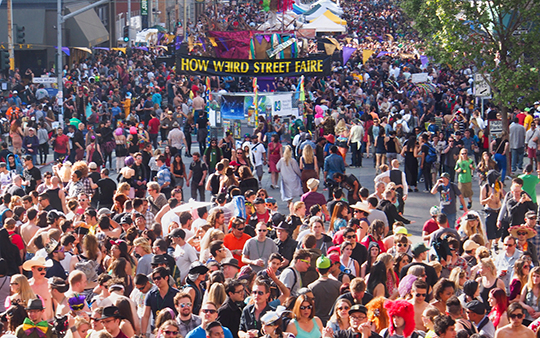
At one of our How Weird Street Faire wrap-up meetings we discussed the idea of adding a comedy stage for the next How Weird. All humor. All the time. For the whole day. The SF-based comedy group "Killing My Lobster" has tentatively agreed to be a part of it.

It is my belief, along with some of the directors of WPTTO, that indeed, laughter can inspire peace. It should be a part of our educational charter to inspire laughter. Like technology, the moods of people can determine their outlook on life. After all, going to war is no laughing matter. In fact, all wars were created in very serious and somber moods.

This blog entry was inspired today when I visited the Lucille Ball-Desi Arnaz Center in Jamestown, NY whose mission "is to preserve and celebrate the legacy of Lucille Ball and Desi Arnaz and enrich the world through the healing powers of love and laughter."

One venture of the center is a program called the "Legacy of Laughter" seminars, or LOLs: panel discussions, with audience interaction, that explore and celebrate the inestimable value of laughter. These are moderated by Lucie Arnaz, and panelists include those who create or perform comedy, who use it in their work, or who have been healed by it. One benifactor of the center claims she was cured of cancer by watching "I Love Lucy" reruns!

Hey, if it's possible to laugh our way out of a serious illness, why don't we try it for other things that have gone wrong in the world? As they say, laughter is the best medicine!

The Peace Train returns

Yusuf Islam, the former Cat Stevens, has quietly returned to music with a new album and concerts. Thirty years after the folk singer converted to Islam, changed his name and dropped out of music, calling it un-Islamic, he has picked up the guitar once more. He has reconciled pop music with his faith and wants to use it to spread a message of peace.

"When I come out now, I sound quite similar. For some people, itís a welcome return to the sound of my voice and my music," says Islam, who as Cat Stevens sold 60 million albums with songs like "Wild World" and "Peace Train".

He said there is interest in his music now because the "tremendous conflicts that have been created by extremists" have created a longing for the peaceful sounds and positive messages of his songs, old and new.

Winners in the Pasay on-the-spot painting and essay-writing contests receive Connie Dy Peace Prizes

Ten students who won in the recently concluded on-the-spot painting and essay-writing contests in Pasay City received their awards and prizes last Dec. 11. The contests were held at the Alleviation Center, 822 Dominguez St., Malibay, Pasay City last Dec. 8. The competitions which was originally slated last November 30 was postponed due to super typhoon Reming.

Elementary pupils competed in the painting contest, while high school students competed in the essay-writing contest. Both competitions tackled the theme "Peace as Seen in the Hearts and Minds of the Pasay Youth".

The project was jointly launched by the Centre for P.E.A.C.E., DepEd-NCR, Pasay Division of Schools, Rotary Club of Masambong ng Quezon City and the Rotary Club of Illustrado together with other Pasay Rotary clubs, and the Office Pasay Congresswoman Connie Dy.

The winning contestants received the Connie Dy Peace Prizes of P5,000 for the 1st place; P3,000 for 2nd place; P2,000 for 3rd place and P1,000 each for the 4th and 5th placers. These separately applied to winners in both the painting and essay-writing contests. The schools of the two 1st placers each received an audio-visual showcase.

The winners, together with their parents, teachers and principals were honored in fitting ceremonies last Monday (Dec. 11) between 8-11 in the evening at the Forum Hall, Airport Casino, Paranaque City.

Kapayapaan sa puso at diwa ng kabataang Pasay (peace as seen in the hearts and minds of the Pasay youth) represents the second leg in implementing the agreement between DepEd and the Centre for P.E.A.C.E. in promoting a culture of peace among the ranks of students nationwide. The first successfully launching was the Kapayapaan sa puso at diwa ng kabataang Kyusi (peace as seen in the hearts and minds of the Quezon City youth) last September, which was recognized as a part of the UN-mandated peace celebrations worldwide. It was adopted by the Rotary Club of Masambong in Quezon City which in turn rallies the support of other Rotary clubs in spreading peace consciousness among the youth in their respective jurisdictions.

Turning guns into guitars

The Battalion of Immediate Artistic Reaction is a group of Columbian musicians and political activists who are tired of Colombia's four-decade old civil war. They are committed not only to making music, but also making peace; by making positive changes for Colombia, reducing the violence, and teaching people to live together.

Cesar Lopez founded the organization in 2003, after the bombing of the El Nogal nightclub which killed 36 people in the capital's trendy Zona Rosa district. The unnecessary violence gave Lopez an idea. "We were playing our music on the streets near the club," says Lopez, "when I noticed that a soldier was holding his rifle the same way I was holding my guitar."

He then set out to convert used guns into musical instruments. "In the first one," explains Lopez, "the guitar isn't well integrated with the gun. But it's better now. The gun is in service to the guitar, which is the idea." Lopez gets the guns through an anti-land mine group connected to Colombia's peace commissioner's office. Most of the firing components are removed so it can no longer be fired. Then a guitar maker adds the fretboard, strings, and neck as well as an input for an electric amp.

Cesar Lopez is a classically-trained musician and composer who studied at Colombia's best conservatory, but instead of concert hall performances he chooses to play his music on the streets of Bogota. Using the Internet, the Battalion of Immediate Artistic Reaction mobilizes every time there is some kind of guerrilla attack in Bogota, heading out into the streets to serenade the victims with soothing music.

"Violence fears love because it is stronger," Lopez says. "Violence fears my voice because it goes beyond death."

"What we want to create is an invitation to an attitude of change," he says. "The main idea is that weapons can be changed from an object of destructiveness to an object of constructiveness."

To learn more about Cesar Lopez and the Battalion of Immediate Artistic Reaction, and to hear some of their music, visit www.cesarlopez.org

Music as a bridge to peace

In October 2005, a "DJ Summit" was held in Jerusalem to show the world that music can overcome differences and bridge cultural gaps. Entitled "Bridge for Peace", the party brought together three DJ's who came from cultures currently at war with one another.

The evening featured the house rhythms of Khalil Kamal from Ramallah in the West Bank, followed by the Arabic groove of Srulik Einhorn from Tel Aviv in Israel, and ended with the progressive house of Morad Kalice from Amman, Jordan. At a time when war has torn apart any political or social cooperation between their home countries, music served to connect them and enable them to see their similarities rather than their differences.

The summit was the idea of Srulik Einhorn, who is credited with helping to introduce Arabic electronic music to Tel Aviv's bars and clubs. After years of playing the music, he began making contact with DJ's in neighboring Arab countries. Einhorn visited Jordan where he met DJ Kalice, and attempted to bring him to a party in Tel Aviv. Kalice was initially refused entry, but eventually, the Interior Ministry issued a visa for Kalice to come to Israel. For the event, they chose the holy city of Jerusalem, and its largest club Haoman 17.

"It's a nice event of cooperation, and it's never been done in the region," said Einhorn. "Also, being in Jerusalem means doing it in the holy city to three religions."

During his performance, DJ Kalice displayed cellular text messages of encouragement from friends back in Jordan. "The message that I want to bring to the people is that music should bring people together," he said.

Khalil Kamal is Ramallah's leading DJ, but was born in Jerusalem. Being a DJ in the West Bank is not easy, and yet the 37 year old father of three has been performing for 11 years.

"It was the first time I was in such an atmosphere with a Jewish crowd. I was afraid that they wouldn't accept me because I'm an Arab. But they accepted everything I played," said DJ Khalil. "It wasn't only music. It was the only night that we felt there was no difference between Israeli, Palestinian, and Jordanian. We hope that they will feel that way on the street."

Because of travel restrictions and little publicity in East Jerusalem, there were mostly Israelis in the audience, many were soldiers on holiday. "It's putting the enemy in the DJ spot, and... he's not the enemy, he's just the guy spinning the records," said one attendee after leaving the club.

"We really enjoy performing together, and this allows the crowd to see that cooperation and coexistence between Israelis and Palestinians is possible." said Srulik Einhorn.

DJ Srulik Einhorn and DJ Khalil will perform together again in London on the winter solstice in December 2006, at a party called "Bridge of Peace".

Ecological Debt Day

Today is the day of the year when mankind over-exploits the world's resources - the day when we start living beyond our ecological means for the rest of the year.

The New Economics Foundation has calculated from research by the Global Footprint Network that the day when our global resource consumption surpasses a sustainable level falls on October 9th this year. The world has a certain quantity of natural resources that can sustainably be used up each year, today is the date at which this annual capacity is reached.

The Global Footprint Network estimates that the human race is over-using the Earth's resources by 23 per cent. While each individual should use up no more than the equivalent of 1.8 hectares of the Earth's surface, the actual area we use is 2.2 hectares per person. The United States leads the world in resource consumption.

Mathis Wackernagel, executive director of Global Footprint Network, which analyses 6,000 pieces of data, warned that the limit of the Earth's endurance had already been reached.
Humanity started living beyond its means on a global level in 1987, when the limit of sustainability was reached on December 19th. The date of the Ecological Debt Day has started earlier every year since then. Last year it occurred on October 11th.

Global Footprint estimates the world would need five planet Earths to sustain a global society such as that in the US, while almost three Earths would be needed for a global society such as that in the UK. This year's global Ecological Debt Day meant that it would take the Earth 15 months to regenerate what was consumed this year. As global resources shrink, there will be more likelihood of competition for those resources, leading to conflict and war.

Junk Media

Have we thought about how we feed our heads.

We now pay attention to what we put in our bodies, more or less, but have we really started to think about what we put in heads. I’m talking about “junk media.”

For years and years Americans have subsisted on an intellectual diet of vapid soap operas and sitcoms. If this is not bad enough at key temporal junctures (when our attention is greatest) these dramas are interrupted by efforts to sell us products we usually do not need and can ill afford. Products such as bread, with little nutrional value; vehicles, such as SUVs, which have little correspondence with actual use unless such use is to waste valuable fuel and parking space; or loan programs, with high interest rates, we can not afford to pay off.


HELP US

Please donate to the non-profit World Peace Through Technology Organization to help us continue all of our peacemaking efforts!

flickr tag "howweird"

www.flickr.com

This is a Flickr badge showing public photos from Flickr tagged with howweird. Make your own badge here.


User login

Log in using OpenIDCancel OpenID login

Bookmark Us

Bookmark Website 
Bookmark Page